

Women's networking groups are more than just places to meet and greet. They are essential resources for referrals, advice, and introductions, offering a peer group that has faced similar challenges. But with so many options, how do you choose the right one? Understanding the different types of women's networking groups, their costs, and what the research says can help you make an informed decision.
What a women's networking group is for
Women's networking groups serve multiple purposes, from providing referrals and business advice to fostering a supportive community of peers. These groups are designed to help women navigate the unique challenges they face in the business world. One key finding from a 2019 study published in the Proceedings of the National Academy of Sciences (PNAS) by Yang, Chawla, and Uzzi highlights the importance of network centrality and gender composition. Women with a network centrality in the top quartile and a female-dominated inner circle had an expected job placement level 2.5 times greater than those with low centrality and a male-dominated inner circle. The study is correlational, so the finding is a pointer rather than a promise; we come back to it below.
But why do women-only rooms exist? The short answer is that many women want a room where they can share experiences, mentor each other and build connections with peers who recognize the problems they bring. These groups are not just about professional development; they are about creating a community that understands and supports the unique challenges and opportunities women face.
The four main types
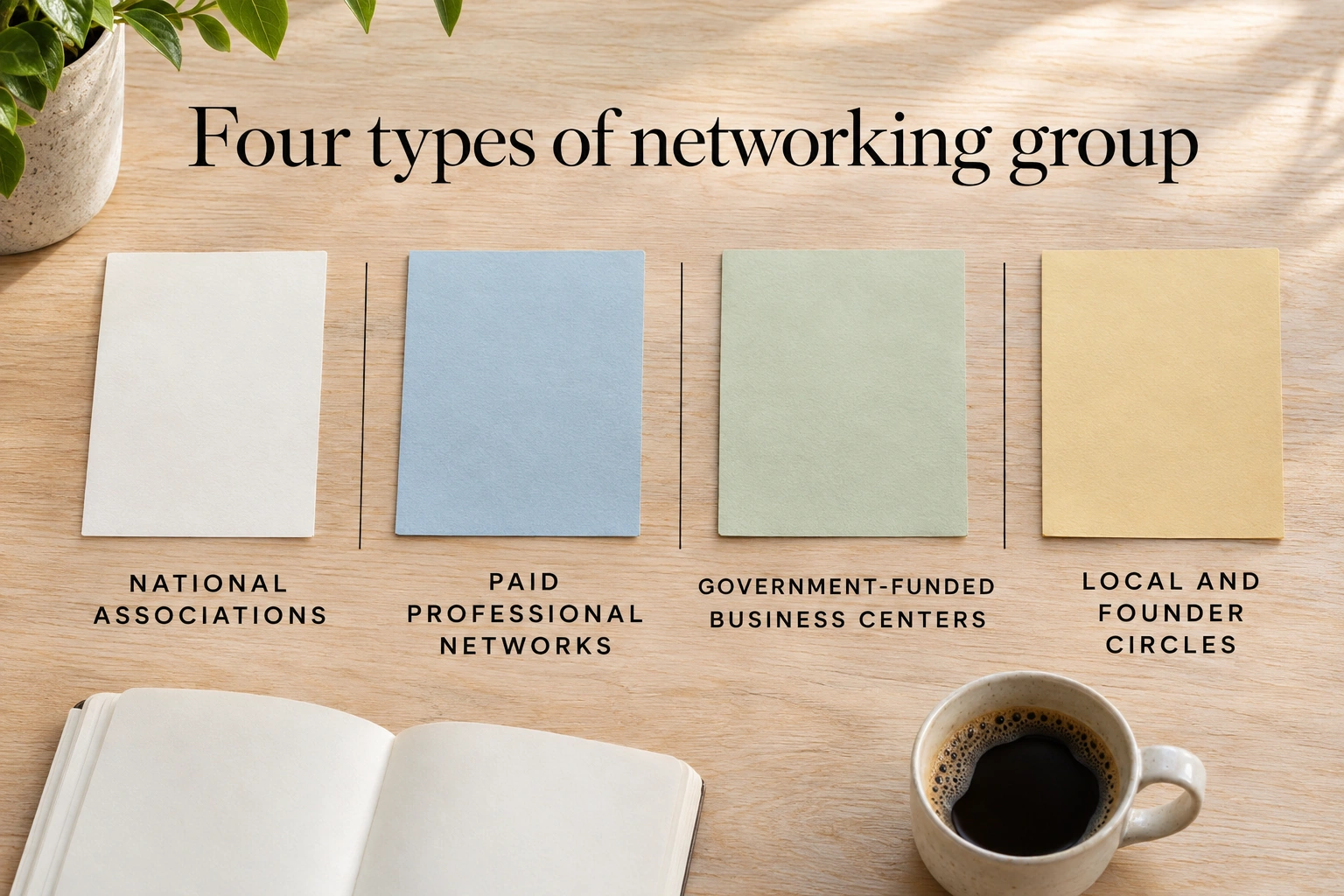
Women's networking groups come in various forms, each with its own structure and benefits. Here are the four main types:
- National associations: Large, dues-based organizations that represent the interests of women entrepreneurs across multiple industries.
- Paid professional networks: Exclusive membership programs that offer a range of professional development resources and networking opportunities.
- Government-funded business centers: Advisory centers that provide support and resources to small businesses, serving both women and men.
- Small local or founder circles: Informal, often grassroots groups that focus on local connections and peer support, much like a mastermind group with a looser format.
National associations
National associations, such as the National Association of Women Business Owners (NAWBO), are large, dues-based organizations that represent the interests of women entrepreneurs across multiple industries. Founded in 1975, NAWBO describes itself as the unified voice of over 11.6 million women-owned businesses in the United States. These organizations offer a wide range of resources, from networking events to advocacy efforts, making them suitable for women entrepreneurs who want to connect with a broad network and influence policy.
Another example is the US Small Business Administration's (SBA) Office of Women's Business Ownership, which funds more than 100 Women's Business Centers across the country. These centers provide advisory services and resources to small businesses, serving both women and men. Established in 1988, the program offers a supportive environment for business owners, but these centers are not member networks. They focus on providing advice and resources rather than creating a membership community.
Paid professional networks
Paid professional networks, such as Ellevate Network and Chief, offer exclusive membership programs designed to provide high-level professional development and networking opportunities. Ellevate Network, for example, offers several membership levels, starting with a free Guest level; the prices are in the next section. These networks are ideal for women who are looking for a more structured and resource-rich environment.
Chief, another prominent paid network, has stringent entry criteria. Chief lists 15+ years of leadership experience among its criteria, with a CXO route at an organization with 1,000+ employees and a Builders route for $2 million+ annual revenue or venture funding. It is a room for senior leaders, closer in spirit to the CEO peer groups we have compared before than to a casual mixer.
What they cost, where published
Ellevate Network, a prominent women's professional network, offers several membership tiers. The free Guest level provides access to some community features. The Pro tier costs $40.00 per month when paid up front, while the Executive tier is $150.00 per month when paid up front. The Enterprise tier is priced on request, catering to larger organizations. These options provide a range of access levels and costs, making it a flexible choice for women at different stages of their careers.
Chief, another high-profile network, targets senior leaders and founders. Chief's membership guide, checked in October 2026, lists $5,900 per year for the standard Membership level and $9,800 per year for the Signature level, with a one-time $500 new member fee.
NAWBO (National Association of Women Business Owners) describes itself as a dues-based organization; we do not quote its dues here, so ask the chapter you would join. NAWBO describes itself as the unified voice of over 11.6 million women-owned businesses in the United States, representing the interests of all women entrepreneurs across all industries.
The US Small Business Administration's Office of Women's Business Ownership funds more than 100 Women's Business Centers. These centers provide advising services to small businesses, serving both women and men. There is no membership to compare here: the SBA describes them as advising centers, which makes them a useful first stop for practical business questions.
The Longevity Social Club, the publisher of this article, offers The Community for free and The Club for $97 a month or $970 a year.
The club's six event formats are cowork days, talks and workshops, dinners and socials, hot seats and pitches, wellness and mentorship, and retreats. We list ourselves last on purpose: compare us on the same questions as everyone else.
Many local women's networking groups do not publish their prices, which can make it difficult to compare costs. When considering a local group, ask for the full annual cost in writing before you pay, including any joining fee.
What the research says about women's networks
A 2019 study by Yang, Chawla, and Uzzi published in the Proceedings of the National Academy of Sciences (PNAS) analyzed the impact of network structure on job placement. The study, which followed 728 graduates of one top-ranked US business school, 186 of them women, found that women with a network centrality in the top quartile and a female-dominated inner circle had an expected job placement level 2.5 times greater than women with low centrality and a male-dominated inner circle. It is observational and correlational: a central network and a close circle of women were linked with better placement, which is not the same as causing it.
The findings highlight the importance of both breadth and depth in women's networks. A broad, well-connected network can provide access to a wide range of opportunities and resources, while a close-knit circle of women can offer emotional support and mentorship. This dual approach can be particularly beneficial for women founders and operators, who often have few peers in their own building.
When choosing a women's networking group, consider the balance between a large, diverse network and a smaller, more intimate circle. A group that offers both can provide the best of both worlds, helping you build a robust support system and access valuable opportunities.
How to choose one
When evaluating women's networking groups, several key factors can help you make an informed decision:
- Who is in the room? Consider the stage and industry of the members. Are they at a similar stage in their careers as you? Do they operate in related industries? A group with members who share your professional context can provide more relevant insights and connections.
- How often does it meet? Frequency can impact the depth of relationships and the consistency of support. A group that meets regularly, whether in person or online, can foster stronger connections and more frequent opportunities for collaboration.
- What does it cost per year? Add up the full annual cost, including joining fees, and weigh it against what you will actually use. Prefer groups that publish their prices, the way we set out how our membership tiers compare.
- Is there a small circle inside a big network? A combination of a broad network and a smaller, more intimate group can be particularly valuable. A large network provides access to a wide range of opportunities, while a smaller circle offers deeper support and mentorship.
- Can you visit first? Ask whether you can attend once as a guest, and use that visit to get a feel for the group's dynamics and see if it aligns with your needs and values.

Local versus online groups also play a role in your decision. Local groups can provide in-person connections and a sense of community, while online groups offer flexibility and access to a broader network. Consider your preferences and schedule when choosing between local and online options.
How to start your own
If you can't find a women's networking group that meets your needs, starting your own is often the better route. Here are some steps to consider:
- Pick a format: Decide on the structure of your group. Will it be a formal organization with regular meetings, or a more informal gathering? Consider the format that best suits your goals and the preferences of potential members.
- Establish a fixed rhythm: Consistency is key to building a strong network. Set a regular meeting schedule, whether it's monthly, bi-weekly, or quarterly. This helps members plan and commit to participation.
- Cap the size: A smaller group can foster deeper connections and more meaningful interactions. Consider capping the number of members to ensure a manageable and intimate environment.
- Choose a host: Designate a host or a rotating host to manage logistics and facilitate meetings. This can help maintain structure and ensure smooth operations.
- Set a simple rule for what members bring: Define what each member is expected to contribute, whether it's a specific skill, a business update, or a resource. This helps create a dynamic and mutually beneficial environment.
Starting your own group allows you to tailor the experience to your specific needs and the needs of your community. It can also provide a sense of ownership and fulfillment as you build a supportive network of like-minded women.
The practical takeaway
When choosing among women's networking groups, consider the balance between a broad, well-connected network and a close-knit circle of women. Evaluate the cost, frequency of meetings, and the stage and industry of the members. If you can't find a group that fits your needs, consider starting your own with a clear format, fixed rhythm, and manageable size. The right group is the one you will still be attending a year from now.
If you would rather join a room that is already running, apply to The Longevity Social Club.