

Making friends as an adult can feel like a daunting task. The ease with which we formed friendships in school and early jobs is often a distant memory. But the need for connection remains strong. According to the US Surgeon General's 2023 advisory, approximately half of U.S. adults report experiencing loneliness. For busy women founders and operators, the challenge has its own shape. The demands of work and personal life can leave little time for building new relationships. So, how do you actually make friends as an adult? The answer lies in understanding the science of friendship and applying practical strategies.
Why making friends as an adult feels hard
The transition from school and early career to adulthood often marks a significant shift in social dynamics. In school and early jobs, repeated contact was almost guaranteed. Classrooms, dormitories, and office spaces provided a natural environment for social interaction. These settings ensured that you saw the same faces regularly, making it easier to form and deepen friendships. However, adult life tends to scatter us. Jobs become more demanding, and personal commitments multiply. The structured environments that once facilitated friendships are no longer a given.
The statistics bear this out. According to the Pew Research Center's 2023 survey of 5,057 U.S. adults, 8% have no close friends, 53% have 1 to 4, and 38% have 5 or more. Among women, 36% have 5 or more close friends. Most adults, in other words, have a small circle, and a meaningful minority have none. The lack of structured social environments means that forming new friendships requires more intentional effort.
The problem is further compounded by the fact that adult friendships often lack the built-in repetition that characterized our younger years. School and early jobs provided a consistent backdrop for social interaction. In contrast, adult life is marked by more transient and sporadic encounters. This makes it harder to build the kind of deep friendships that we value.
How many hours a friendship takes
Forming a friendship as an adult is not a quick process. A University of Kansas study by Jeffrey Hall found that it takes between 40 and 60 hours to form a casual friendship, 80 to 100 hours to become a friend, and more than 200 hours together to become good friends. The study drew on two samples: 355 adults who had recently moved and were surveyed online, and 112 University of Kansas freshmen. These ranges provide a framework for understanding the time investment required to build meaningful relationships.
Let's break this down in practical terms. If you spend a couple of hours a week with the same person, it would take about 20 to 30 weeks to reach the 40 to 60 hours of a casual friendship. For a more substantial friendship, you would need to invest 40 to 50 weeks. These figures might seem daunting, but they underscore the importance of consistency and repeated contact.

For women who are busy with work and personal commitments, finding the time to invest in friendships can be challenging. The workable answer is to integrate social time into your existing routines. For example, if you have a weekly workout class or a regular dinner with colleagues, these can serve as opportunities to build and deepen connections. The gradual accumulation of shared experiences is what ultimately solidifies a friendship.
Go where you see the same faces
Repetition is a crucial factor in forming friendships. One-off events, while enjoyable, are less effective for building lasting relationships. Instead, recurring settings provide the necessary consistency to foster deeper connections. Here are some practical options:
- Weekly classes: Whether it's a fitness class, a language course, or a creative workshop, regular attendance ensures you see the same people regularly.
- Volunteer shifts: Volunteering for a cause you care about can be a rewarding way to meet like-minded individuals.
- Regular dinners: Organizing or joining a regular dinner group can create a consistent social environment; our guide to women's social clubs maps the main types.
- Cowork days: If you work from home or have a flexible schedule, coworking spaces can provide a sense of community and regular social interaction.
- Team activities: Joining a sports team or a community group can offer structured opportunities to connect with others.
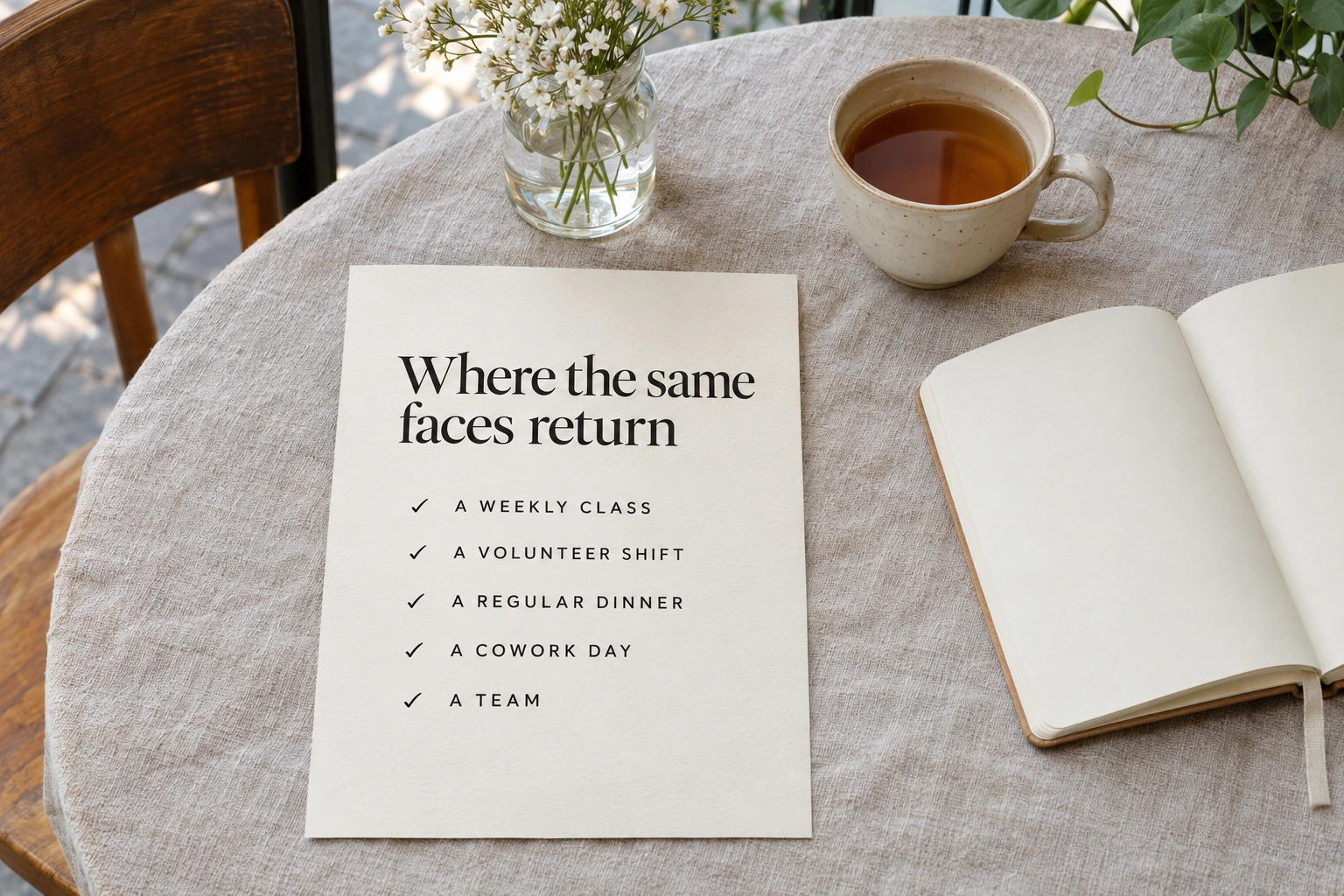
Repetition matters because it allows you to build a shared history with others. Each repeated interaction adds a layer to your relationship, making it more robust and meaningful. The University of Kansas study underscores this point by highlighting the number of hours required to form different levels of friendship. By choosing activities that ensure you see the same faces regularly, you increase your chances of forming lasting connections.
A disclosure, since we publish this: The Longevity Social Club runs recurring dinners, cowork days and talks among its six event formats. It is one option among the many above, and the same test applies: will you see the same people next month?
Turning acquaintances into friends
Making the leap from acquaintance to friend can feel daunting, but it can be managed with intention. The Kansas ranges are benchmarks, not rules, and the hours only start to count when you spend time together on purpose.
One effective strategy is to suggest a second meeting outside the initial setting. If you meet someone at a networking event, don't just exchange business cards and hope for the best. Follow up with a specific invitation. For example, "I enjoyed our conversation. How about we grab coffee next week?" This shows you are genuinely interested and willing to invest time.
For introverts and those with social anxiety, smaller, more structured settings can be more comfortable. One-on-one meetings, such as a coffee date or a short walk, can be less overwhelming than larger group activities. Structured activities, like a fitness class or a book club, provide a built-in topic of conversation and a clear end time, which can ease the pressure.
If social anxiety stops you from getting through ordinary days, that is worth raising with a clinician. Otherwise, small, deliberate steps help. The key is consistency and specificity in your invitations. By suggesting concrete plans, you reduce the ambiguity and make it easier for the other person to say yes.
Making friends as a woman over 30
The landscape of friendship can shift dramatically after 30. Pew Research Center found that 36% of women have five or more close friends, which leaves most women with a smaller circle. Moves, children, and career demands can disrupt social networks, making it challenging to maintain or form new friendships.
No primary source names a single hardest age to make friends, but the transition to new life stages can certainly make it more difficult. For example, having children often means less free time and different social circles. Career changes or relocations can also lead to a loss of consistent social contact. However, the key to building new friendships is not the age but the time and repetition of contact.
Jeffrey Hall's research underscores the importance of consistent interaction. It takes between 40 and 60 hours to form a casual friendship, which means seeing someone regularly is crucial. Joining a regular class, group, or club can provide the repeated exposure needed to build a friendship. Our map of women's networking groups covers the work-adjacent version. Whether it's a fitness class, a book club, or a volunteer group, these settings offer the opportunity to see the same faces and build a connection over time.
For women over 30, it's also important to recognize that friendship can take different forms. It doesn't always have to mimic the intense, daily interactions of college or early adulthood. Quality can often outweigh quantity. A handful of meaningful, supportive friendships can be more fulfilling than a large, less connected group.
When work is the reason you are lonely
For founders and operators, work can be both a source of pride and a cause of loneliness. The demands of running a business often crowd out time for social activities, and the hierarchical nature of work can make it difficult to form genuine friendships with colleagues. Reports and subordinates are not the same as peers and confidants.
Jeffrey Hall's study highlights the importance of repeated contact in forming friendships, but the nature of work can make this challenging. Long hours and a high-pressure environment can leave little room for the casual, unstructured interactions that are crucial for building bonds. However, treating friendship like a recurring meeting can help. Schedule regular times to connect with peers, whether it's a weekly lunch, a monthly coffee, or a recurring happy hour.
One option is a small peer group of founders, such as a mastermind group, which meets on a fixed rhythm with the same people. That is the Kansas arithmetic, built into a calendar.
Loneliness is a common experience, with approximately half of U.S. adults reporting feelings of loneliness, according to the US Surgeon General's 2023 advisory. For founders and operators, the useful response is practical: put people on the calendar before the work fills it. Some founders use a club as that calendar; what each membership tier includes is set out on our site.
The practical takeaway
To make friends as an adult, pick one recurring setting where you can see the same people regularly. Whether it's a fitness class, a book club, or a free community to start in, consistency is key. Once you've formed a connection, suggest a second meeting outside that setting. By being specific and intentional with your invitations, you can turn acquaintances into friends.
If you want a set of recurring rooms to begin with, apply to The Longevity Social Club.