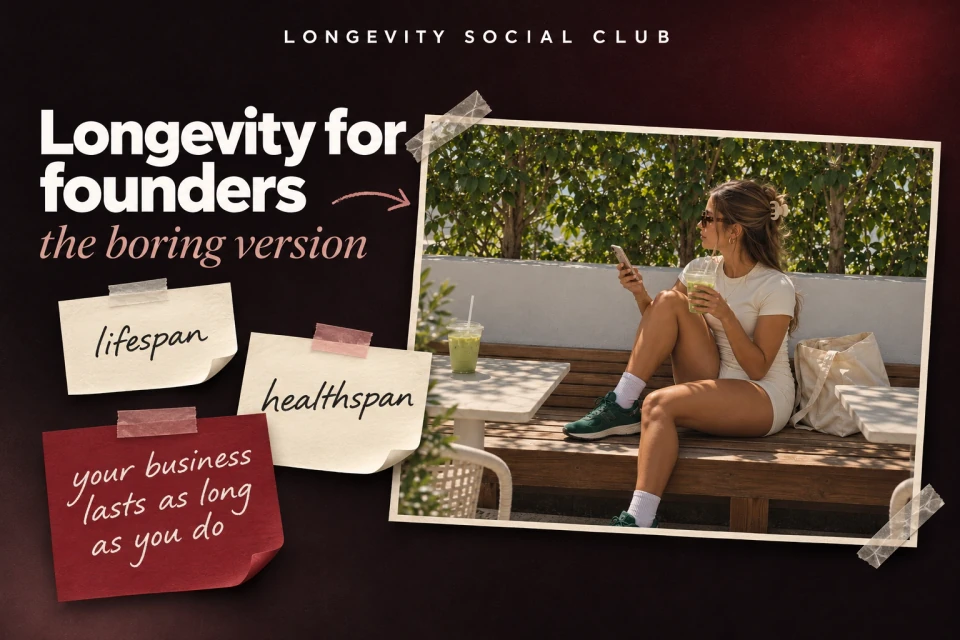
Longevity has a marketing problem, which is that the loudest people in it are the least representative. If your reference points are full-body scans and hundred-item supplement stacks, the sensible response is to conclude that none of it applies to you, and then to do nothing.
That is the wrong conclusion, but it is a reasonable one. So here is the version with the theater removed.
The premise
Your business lasts exactly as long as you do. That is not a wellness slogan, it is a statement about key-person risk. Most founders will accept a great deal of personal cost for a company they intend to run for a decade or more, without noticing that the cost is being drawn from the same account that funds the decade.
The distinction that makes this tractable is between lifespan and healthspan: how long you live versus how long you live in good working order. Founders do not usually need to think about the first. The second is directly load-bearing for the plan.
The short list
Almost everything with strong evidence behind it is dull, free or cheap, and takes years to show a result, which is precisely why it does not sell well.
- Resistance training, twice a week, permanently. A 2022 meta-analysis of cohort studies found muscle-strengthening activity was associated with a 10 to 17% lower risk of death from any cause, with the largest reduction at roughly 30 to 60 minutes a week. The studies are observational, but the direction is consistent.
- Cardiovascular fitness. In a study of more than 120,000 adults who had a treadmill test, lower fitness was associated with higher long-term mortality, with no upper limit to the benefit observed, and its effect was comparable to or greater than traditional risk factors. It responds to ordinary aerobic work; it does not require a lab.
- Sleep regularity, not just duration. In a UK Biobank study of about 61,000 adults wearing activity trackers, going to bed and waking at consistent times predicted mortality better than how long people slept. It is also the variable founders sacrifice first.
- Protein and enough food. Under-eating during high-output periods undermines the training that would otherwise be working. The Menopause Society suggests women in midlife aim for about 1.2 g of protein per kilogram of body weight a day to help preserve muscle.
- A baseline blood panel, repeated. One reading tells you almost nothing. The same panel a year apart tells you a direction, and direction is the only thing that is actionable.
The women's version is missing
The longevity industry is largely gender-neutral in its marketing and largely male in its default assumptions. The result is that the questions many women in their thirties and forties are actually asking, about hormonal change, sleep disruption, bone density, training through cycles, and what perimenopause does to cognition and mood, are answered worst by the brands claiming to have the most rigorous science.
The timing is not incidental. According to the US Office on Women's Health, perimenopause usually starts in a woman's mid- to late forties and can last two to eight years. Those years overlap with peak career responsibility, which means a large number of women are managing a significant physiological transition at the same time as their largest professional load, usually without naming it to anyone at work.
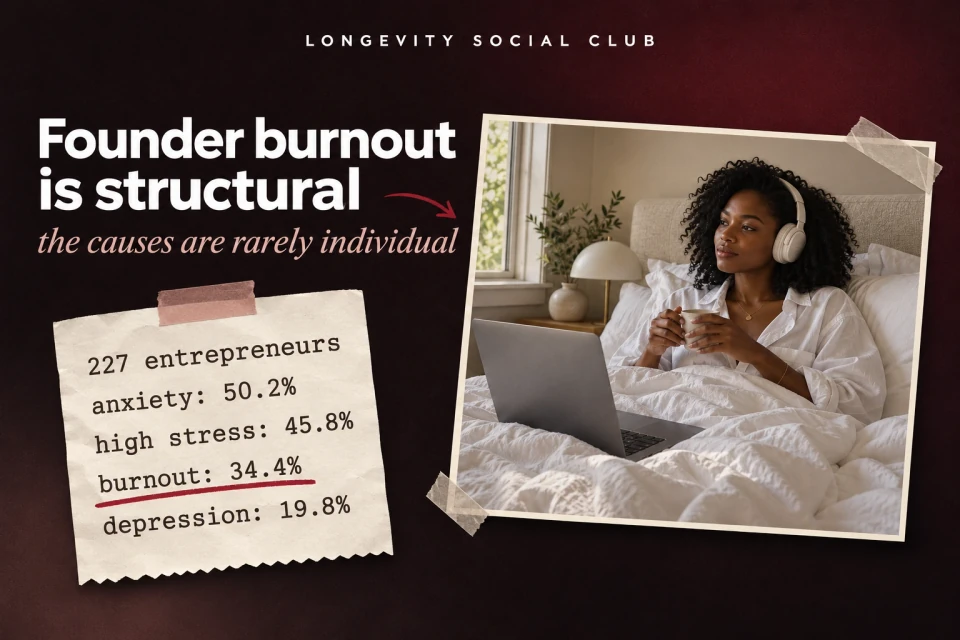
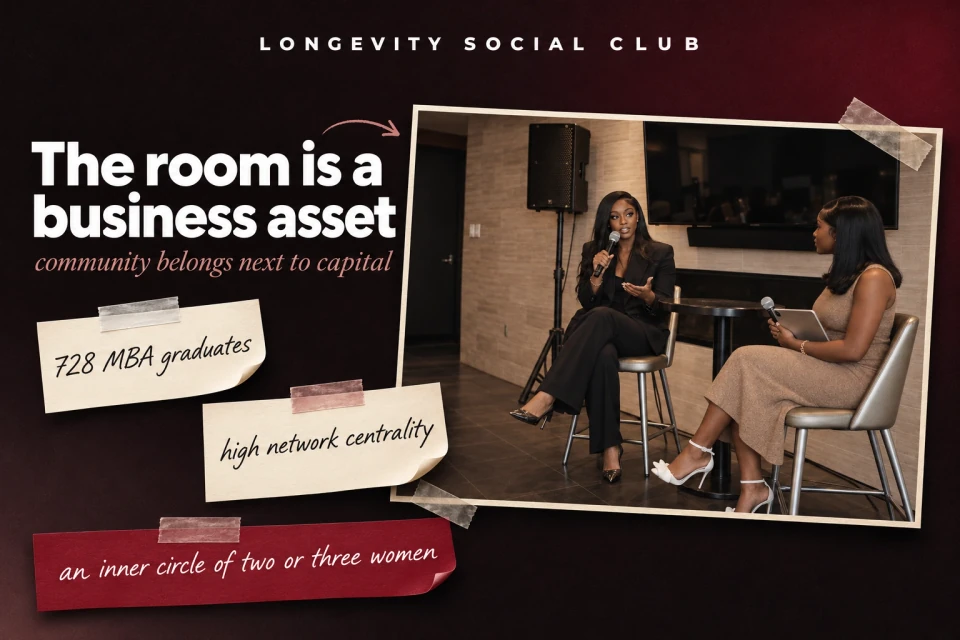
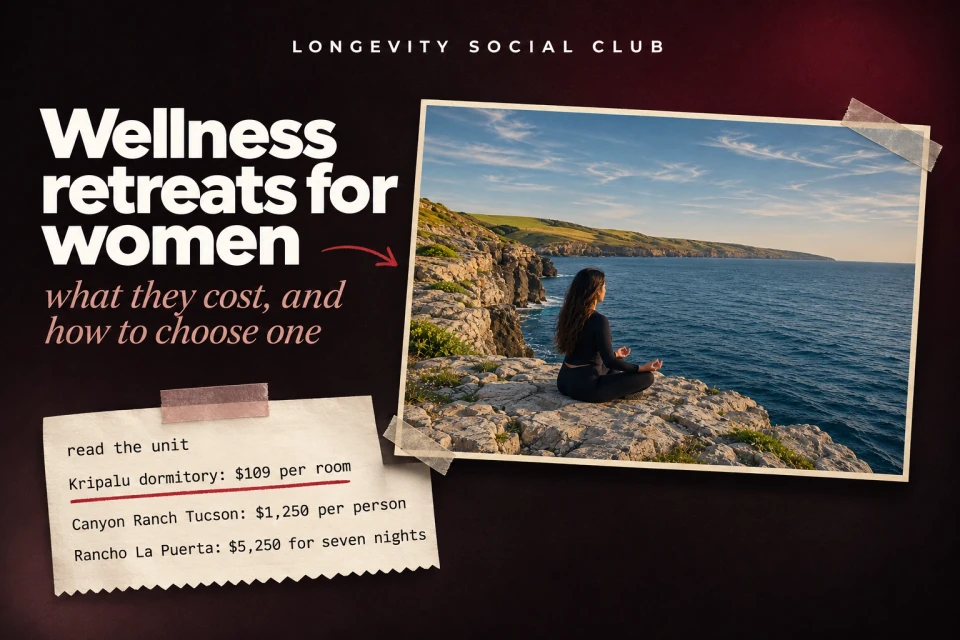
We do not have a protocol for that, and we would be suspicious of anyone who claimed to. What we have is a room where the question can be asked out loud, and sessions that bring in people qualified to answer it. We also write about why founder burnout is structural and what to look for if you are comparing wellness retreats for women.
How to start if you are not going to start
The realistic version, for someone with no spare hours: two strength sessions a week that you schedule like client calls, a fixed sleep window you defend on weeknights, one blood panel this quarter, and the same panel again next year. That is the whole thing. Everything else is optional, and most of it is optional forever.
Build a company that lasts decades. Then build the life capable of carrying it that long.
If you want to build alongside women who treat healthspan and company-building as parts of the same plan, explore membership at The Longevity Social Club or apply to join.