
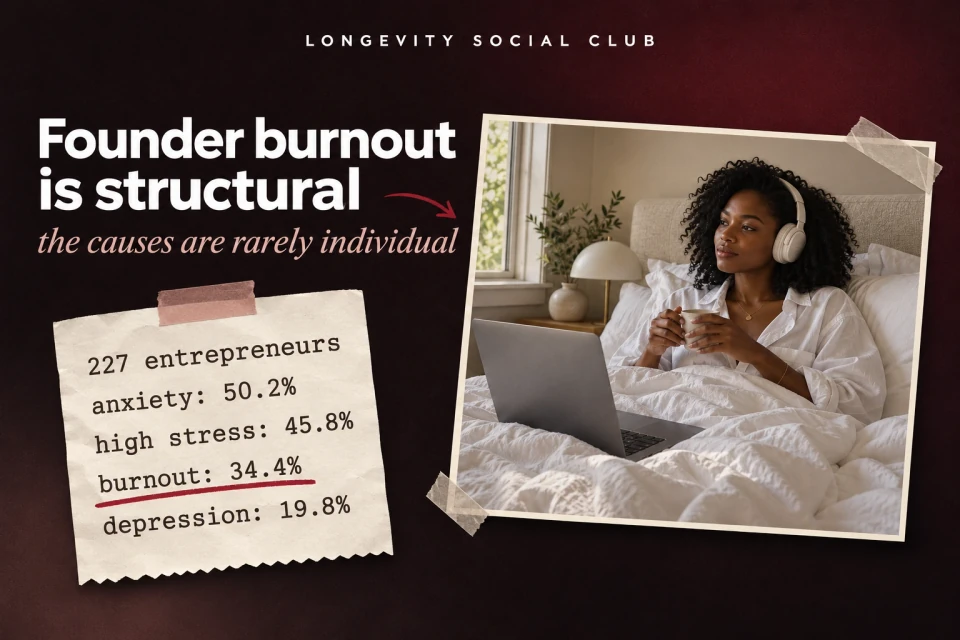
There is a number that circulates in this category: 87% of founders struggle with burnout, anxiety or depression. It is close to something real and it is wrong in a way worth correcting, because the correction is more interesting than the claim.
What the number actually is
The survey behind it asked 227 entrepreneurs across 46 countries about twelve different difficulties. 87.7% reported at least one of the twelve. But the three usually named are individually much lower: anxiety at 50.2%, high stress at 45.8%, burnout at 34.4%, depression at 19.8%. The 87.7% is carrying a much wider basket: financial worry, impostor syndrome, insomnia, loneliness, strained relationships.
It is also a self-selecting online survey run by a content publisher, not peer-reviewed research, and the sample skewed male and young. We cite it because the directional picture is consistent with what founders describe, not because it is authoritative. Anyone presenting it next to a BCG study without flagging the difference is leveling two very different tiers of evidence.
Why the wider basket is the real finding
Burnout gets the headline because it is the recognizable word. But the items with the highest response rates are the ones that describe the structure of the job rather than a clinical state: worrying about money you cannot yet forecast, feeling unqualified for a role no one appointed you to, and having no one to talk to who understands the specifics.
That distinction matters because the standard advice is aimed at the clinical state. Sleep hygiene does not fix undifferentiated responsibility. A meditation app does not fix the fact that you are the only person in your life who knows the runway number.
Three structural drivers
- Undifferentiated responsibility. In most jobs, the boundary of what you are accountable for is drawn by someone else. Founding removes the boundary, and the absence of a boundary is experienced as constant low-grade alertness rather than as freedom.
- Identity fusion. When the company is the answer to “what do you do”, a bad quarter is not a business event. It is a verdict. Keeping an identity that predates the company does not make the quarter better, but it means the quarter is not the whole of who you are.
- Information isolation. Not loneliness in the social sense; most founders have friends. It is that almost nobody in your life can evaluate the decision you are actually agonizing over, so you carry it alone by default.
Structural responses
If the drivers are structural, the responses have to be. That means building things into the calendar rather than relying on discipline in the moment.
- A fixed weekly hour with people solving comparable problems, whether or not you feel you need it that week. The value is in the attendance, not the agenda. We write more about this in why the room is a business asset and what a mastermind group is.
- One person who sees the real numbers. Not a mentor with a general view. Someone with the specifics.
- A written boundary on responsibility: what you own this quarter, and explicitly what you do not. Reviewed monthly, out loud, with someone who will hold you to it.
- One commitment that predates and outlives the company. It sounds soft. It is also the one thing on this list a bad quarter cannot take away. For the physical side of sustaining the work, read longevity for founders: the boring version.
If you are building a company and want a room designed around both the work and the person carrying it, explore membership at The Longevity Social Club or apply to join.