
Choosing the first AI subscription for herself and a small team can be a daunting task for any founder. The market is flooded with options, but two names stand out: ChatGPT vs Claude. Both are AI assistants sold by subscription, with ChatGPT by OpenAI and Claude by Anthropic. The Longevity Social Club publishes this article and teaches Claude in its own course, "Built with Claude: The Founder's Guide to AI," so the reader should weigh the comparison with that in mind. This article provides the prices as of October 28, 2026, the data rules for business plans, and a one-week method to decide which tool best fits your needs.
ChatGPT vs Claude: the short answer
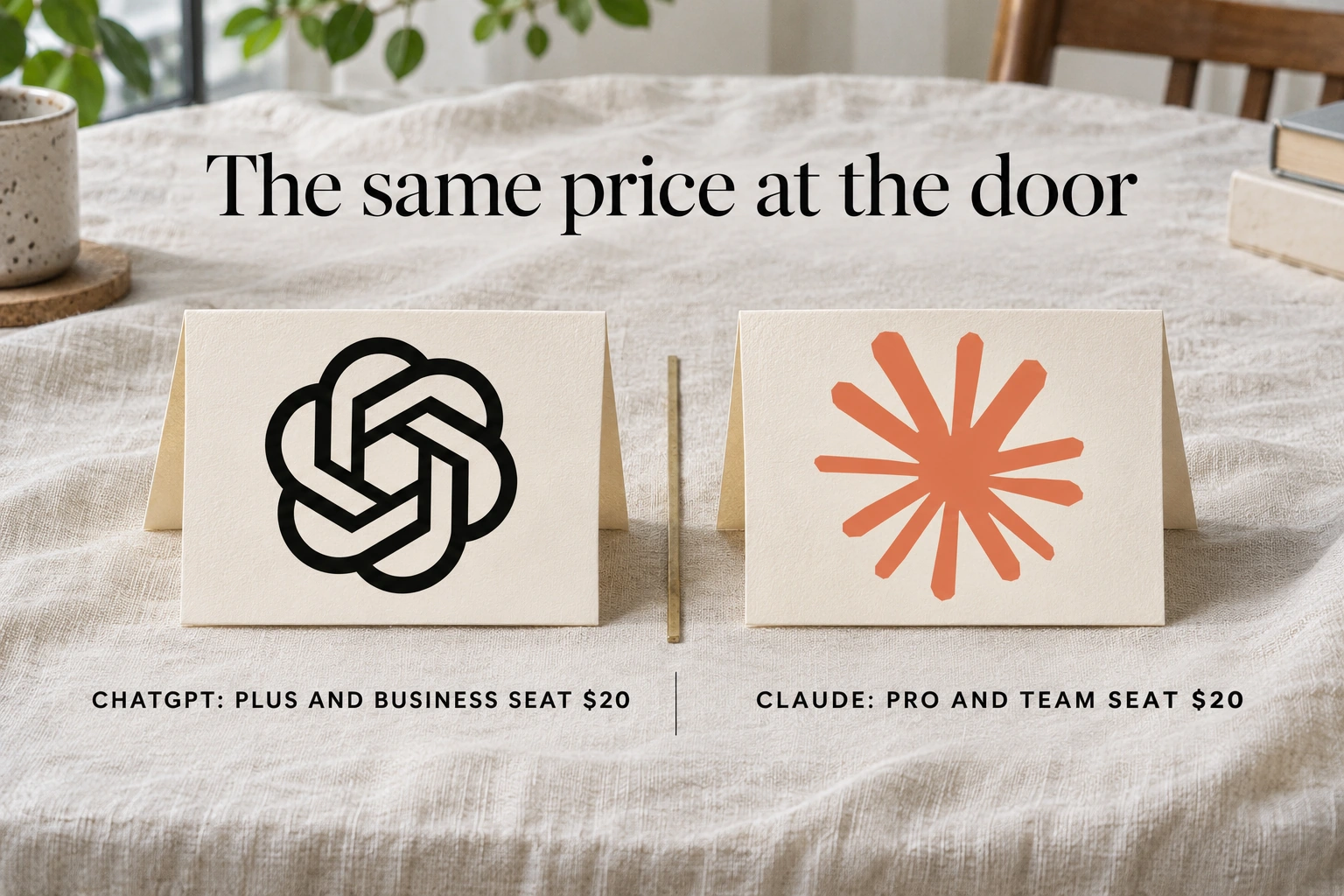
The entry paid tier is $20 a month on both platforms. ChatGPT Plus and Claude Pro are billed monthly, with Claude Pro offering a slight discount at $17 a month if billed annually. Both business plans list a $20 per seat annual charge or $25 per seat monthly, with a two-seat minimum. Neither vendor trains on business-plan data by default. At the entry level, price does not separate ChatGPT and Claude, so the choice comes down to the specific work you do most and how your team is set up.
Understanding the nuances of each plan can help you make an informed choice that aligns with your business goals.
The plans side by side
The figures below were read on the vendors' pages on October 28, 2026, and are US prices excluding tax. Anthropic notes that prices are subject to change at their discretion.
| Plan Tier | ChatGPT | Claude |
|---|---|---|
| Free | Free plan | Free plan, up to 5 projects |
| Entry paid | Plus, $20 a month | Pro, $20 monthly or $17 a month billed annually |
| Higher usage | Pro, $100 and $200 tiers | Max, from $100 a month |
| Business seat billed annually | Business, $20 per user | Team Standard, $20 per seat |
| Business seat billed monthly | Business, $25 per user | Team Standard, $25 per seat |
| Business minimum | 2 seats | 2 seats, up to 150 |
How much is Claude vs ChatGPT? At the entry level, both platforms cost $20 a month. Claude offers a slight discount at $17 a month if billed annually. For higher usage, ChatGPT Pro offers $100 and $200 tiers, while Claude Max starts at $100 a month. Business plans for both platforms are $20 per seat billed annually or $25 per seat billed monthly, with a minimum of two seats.
ChatGPT also lists a Go plan, which may include ads, and an Enterprise plan with custom pricing. Claude lists a Team Premium plan at $100 billed annually or $125 monthly, and an Enterprise plan with a seat price plus usage at API rates, requiring a minimum of 20 seats. Both platforms state that they do not train on your business data by default.
In summary, the pricing structures of ChatGPT and Claude are very similar, with slight variations in the higher tiers and business plans. The choice between the two ultimately depends on your specific needs and how your team operates.
Business plans and what happens to your data
When choosing between Claude and ChatGPT, the business plan and data handling policies matter. For Claude, the Team plan ensures that no model training occurs on your content by default. This policy applies to both the Standard and Premium seat options, which are priced at $20 and $100 per seat annually, respectively. On the Free, Pro, and Max plans, model training is opt-out, giving you control over your data. The Pro plan costs $17 a month billed annually or $20 monthly, while the Max plan starts at $100 a month for 5x more usage than Pro and scales up to 20x.
ChatGPT's business plans, specifically the Business and Enterprise tiers, state that OpenAI will not train on your workspace's data. The Business plan is priced at $25 per user per month billed monthly or $20 billed annually, with a minimum of two seats. Individual plans, such as Plus and Pro, offer an opt-out for data training. The Plus plan costs $20 a month, and the Pro plan comes in $100 and $200 tiers, offering 5x and 20x the usage of Plus, respectively.
For founders, the key distinction lies in the individual versus business plan. If you're using an individual plan, it's essential to check the data training settings to ensure your content remains private. The seat rules also matter: Claude Team requires a minimum of two members and supports up to 150 seats, while ChatGPT Business has a minimum of two seats. The usage multiples for Claude Team are 1.25x for Standard and 6.25x for Premium, compared to the Pro plan.
Where each one fits a founder's week
Understanding when to use Claude versus ChatGPT and what each is good for can streamline your workflow. For long document drafting and research, both tools are valuable, but their capabilities differ based on the plan you choose. Claude's Free plan supports up to 5 projects, which can be sufficient for smaller tasks. The Max plan, starting at $100 a month, is designed for heavier use and provides 5x to 20x more usage than Pro.
ChatGPT's Plus plan, priced at $20 a month, includes projects on every plan, making it suitable for a range of tasks. The Pro tiers, at $100 and $200, offer 5x and 20x more usage, respectively. The Business plan, at $25 per user per month, does not train on workspace data.
Claude's Team plan adds value with its connectors to Google Drive, Gmail, Google Calendar, GitHub, Microsoft 365, and Slack. For organizing work in projects, Claude's Free plan might suffice, but the Team plan's additional features and usage multiples are listed for teams.
The honest test for which tool fits your week is your own workload. If you frequently handle long documents and do a lot of research, the higher tiers of Claude or ChatGPT might be more suitable. For organizing work and integrating with your existing tools, Claude's Team plan with its connectors can be a strong choice. Ultimately, the best tool is the one that aligns with your specific tasks and team needs.
Using both
Some founders find it beneficial to use both Claude and ChatGPT, keeping one paid plan and one free plan. This approach can double your monthly bill, but it also provides the flexibility to leverage the strengths of each tool.
Gemini is another assistant that often enters the comparison, and the same one-week test applies to it. The key is whether a second tool earns its cost in a real week. If you find that the combined usage of both Claude and ChatGPT significantly enhances your productivity and addresses different aspects of your work, the investment might be worthwhile. However, if the overlap in functionality is too high, sticking to one tool might be more efficient and cost-effective.
How to decide in a week
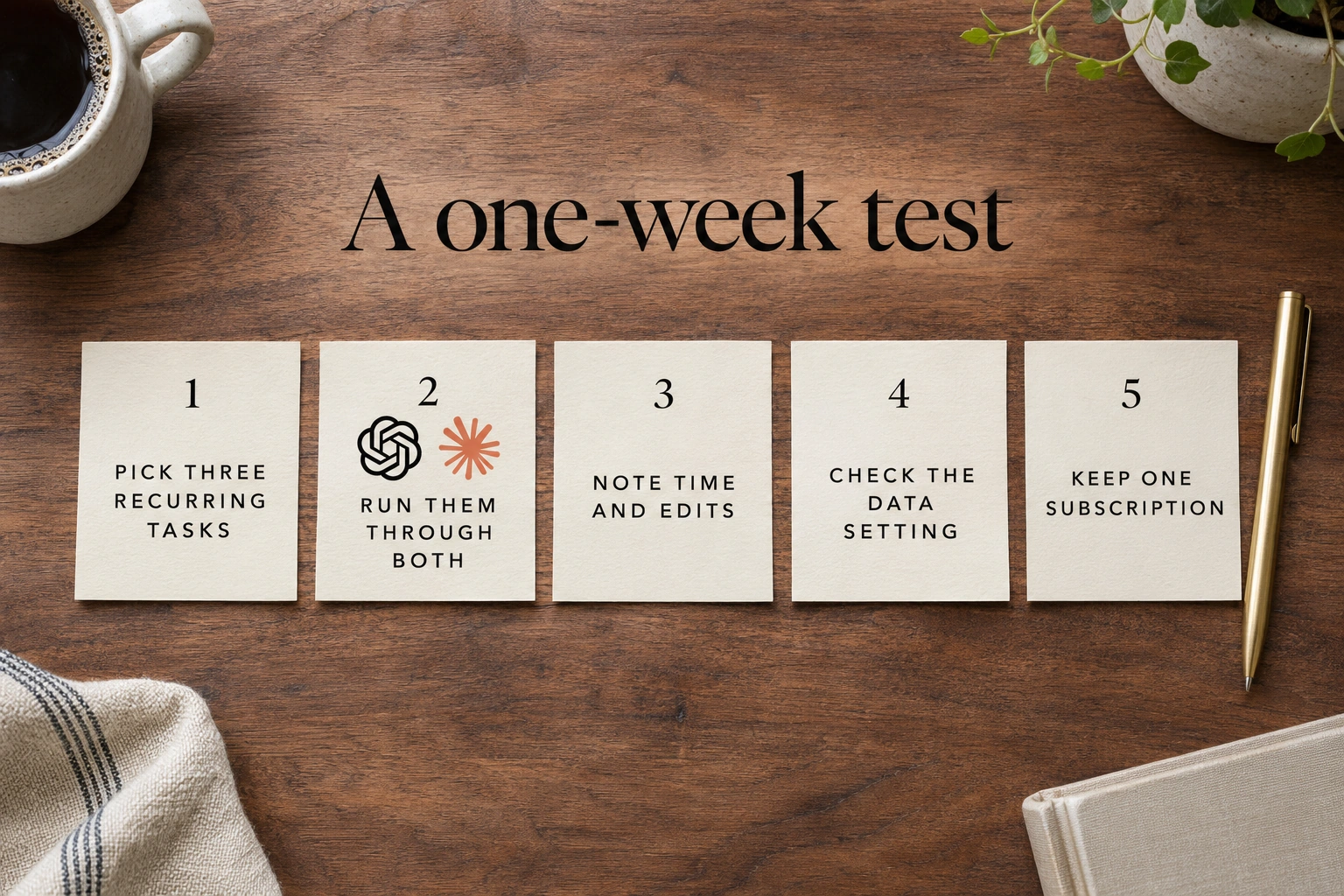
Deciding between Claude and ChatGPT based on a feature list alone can be challenging. The best approach is to test the tools using your own recurring tasks. Start by picking three recurring tasks from your week that are representative of your typical workload. Run the same tasks through both Claude and ChatGPT on the free or entry tier. Note the time it takes to get a usable draft and how much editing is required.
- Pick three recurring tasks from your own week.
- Run the same tasks through both Claude and ChatGPT on the free or entry tier.
- Note the time to a usable draft and how much editing it needed.
- Check the data setting on each plan to ensure your content remains private.
- Decide which subscription to keep based on your test results.
If the results are a tie, consider which tool your team is more likely to open and use consistently. Keep that subscription and revisit your decision in a quarter to see if your needs or preferences have changed.
If the team needs a shared starting point before the test, Anthropic offers free Claude courses.
The practical takeaway
When comparing ChatGPT vs Claude, the best way to decide is to test them with your own recurring tasks. By running the same work through both tools, you can see which one fits your workflow and team dynamics better.
Pay for the one your team keeps opening.
When you want to test tools like these alongside other women running companies, apply to join.