
Before this: Talking to Claude
Article
Brainstorm Without the Mess
A way to go wide on ideas, keep the good ones, and leave the mess behind.
Loading progress…
Overview
Think out loud with Claude without wrecking the thread you actually work in.
When to use this
Any time you are deciding rather than producing.
Who it is for: Anyone whose useful threads slowly fill with half-formed ideas.
Before you begin
- A Claude account
- A decision or a blank page you are stuck on
Step by step
- 1Open a separate thread for thinking, not the one where you do the work.
- 2Load the constraints first: budget, time, who it is for, what you will not do.
- 3Go wide. Ask for twenty, not five, and do not judge while they come.
- 4Extract the winners, and say why each one won.
- 5Poke holes: ask Claude to argue against the shortlist as your most skeptical customer.
- 6Write the decision in one line, then bring only that line back to your working thread.
Brainstorm without the mess
Claude reads the whole thread. That is the thing to understand. Every idea you floated, including the eleven you rejected, is still sitting there shaping what comes next. Brainstorm in your working thread and two things happen: the work gets slower, and rejected ideas keep reappearing in new clothes.
The sandbox rule
Think in a sandbox, not in your kitchen.
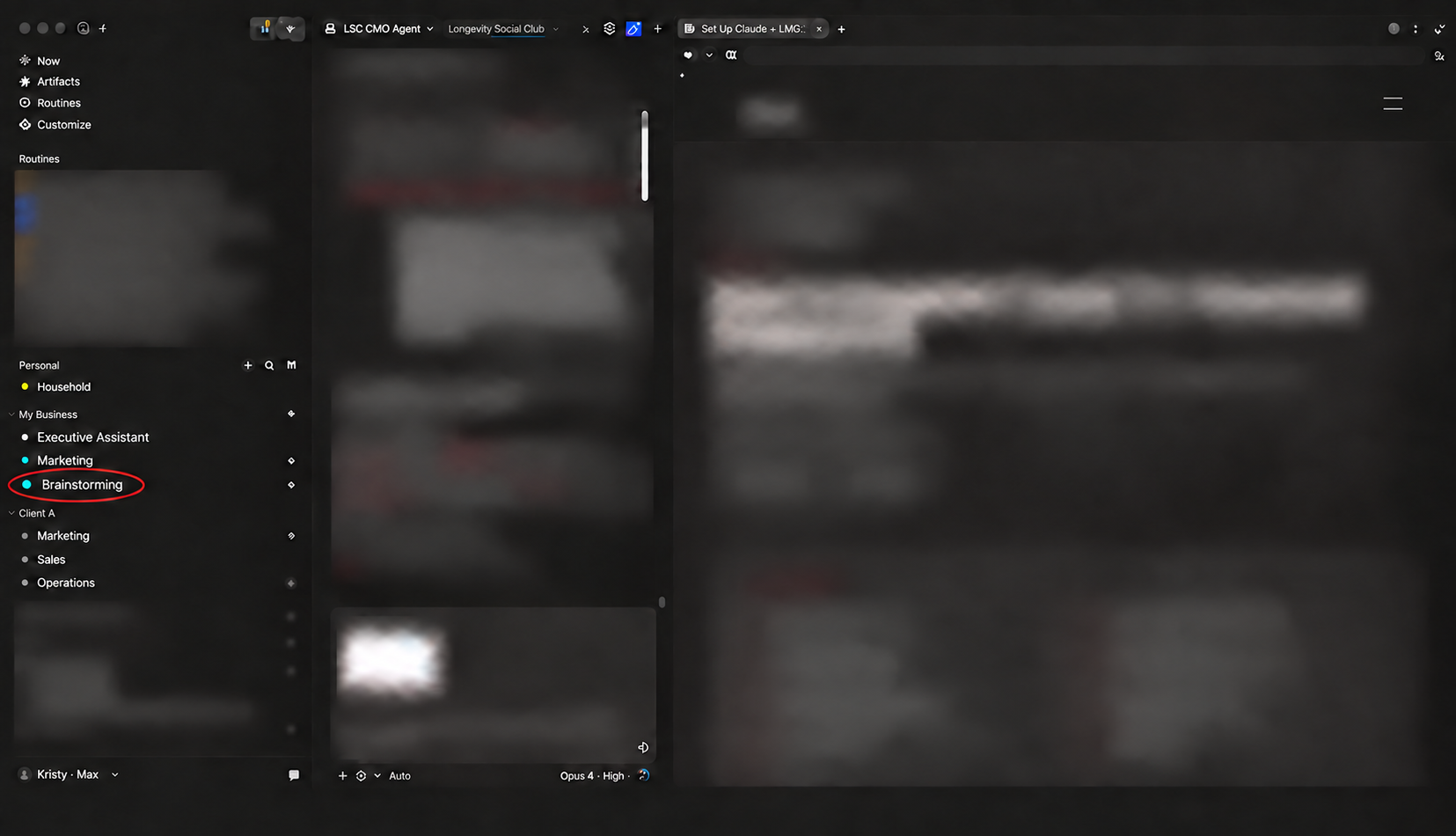
Open a separate thread for the messy part. Go wide, argue with yourself, chase the bad ideas to the end. When you have decided, write the decision in one line, take that line back to your working thread, and leave the rest behind.
The same rule applies to projects. A brainstorm thread inside your business project is fine. A brainstorm inside the thread where you write client copy is not.
The five moves
1. Load the constraints first. Budget, deadline, who it is for, and what you will not do. Constraints make the ideas better, not narrower. Without them you get ideas for a business that is not yours.
2. Go wide. Ask for twenty. Say explicitly that you do not want them filtered yet. The first six will be the obvious ones, and that is fine, they clear the ground.
3. Extract the winners. Pick three or four and say why each one survived. The reason matters more than the pick, because it tells Claude what you are actually optimizing for.
4. Poke holes. Ask it to argue against your shortlist as the most skeptical version of your customer. Then ask what would have to be true for the weakest one to be the right answer.
5. Write the decision. One line, in your own words, with the reason. That line is the only thing that leaves the sandbox.
Keeping client work out of it
A brainstorm invites you to paste in everything you have. Do not paste a client's numbers, contracts, customer lists or anything covered by an agreement into a thinking thread you will never look at again.
Use placeholders. "A clinic doing about $2m" thinks just as well as the real name, and if you later share the thread or reuse it as an example, there is nothing in it you would not want read aloud.
If the client's real numbers genuinely matter to the decision, do that part in the project where their work lives, and keep the sandbox for the shape of the thing.
Checkpoint
You have done this module when you have run one sandbox brainstorm, extracted the winners, and written the decision in a single line. Keep the line. Your content, offer and campaign work all start from decisions like it.
Check Your Understanding
Progress is saved when signed in.
Example output
Example only
A one line decision with the reasoning behind it, and a thread full of discarded options you never have to see again.
Quality check
- Check every fact, figure, and quote against a real source.
- Review the finished work before using or sharing it.
- Remove confidential information that is not needed.
Privacy and safety
Do not include customer records, contracts, credentials, employee information, or confidential material without approval. A qualified person should review decisions involving people, money, health, or legal obligations.
Worth knowing
Ask for twenty ideas. The first six are the obvious ones everyone has, and the interesting ones start after that.
Where this goes wrong
Brainstorming in your main project thread. Everything you rejected stays in the context and quietly shapes the next answer.
You reached the end
Finished this article?
Mark it complete to update your Institute progress.
Loading progress…
Next lesson
05
Claude Memory
Give Claude reliable context about your business, preferences, priorities, and working rules.